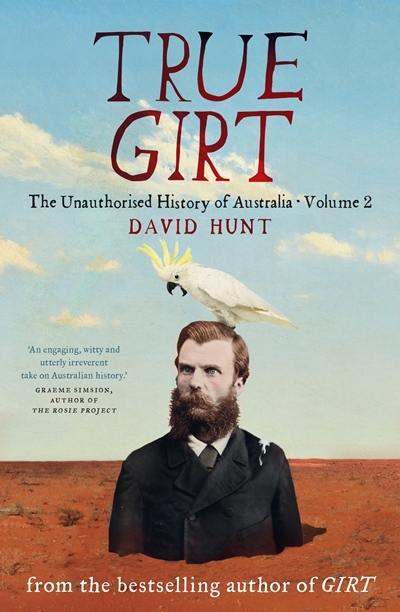
True Girt (The Unauthorised History of Australia #2)
A book recommended by historians at historyaustralia.org.au!
Plot:
David Hunt's first book "Girt: The Unauthorised History of Australia" won the Australian 2014 Indie Award for Non-Fiction Book of the Year. The award is bestowed by Australian independent booksellers, who clearly have excellent taste.
Girt was also shortlisted for the 2014 Australian Book Industry Awards (ABIA), the New South Wales Premier's Literary Awards, the Australian Book Design Awards and was the only non-fiction book shortlisted for the ABA Nielsen BookData 2014 Booksellers Choice Award.
Girt is four parts narrative Australian history and one part satire, mixed in the cultural melting pot, stirred with the wooden spoon of schadenfreude, and garnished with the crushed stems of tall poppies.
True Girt, volume 2 of The Unauthorised History of Australia, was published in 2016 and shortlisted for Audiobook of the Year at the 2017 ABIAs and for the Russell Prize for Humour Writing .
David's first childre
n's picture book, The Nose Pixies, was also published in 2016. It is illustrated by the award-winning Lucia Masciullo. The Nose Pixies is a tale of a father's love, a son's nose picking and the bedtime story that cured him of his habit.
David's second picture book with Lucia Masciulo, My Real Friend, is about friendship and the existential angst of being an imaginary friend.
David has a birthmark that looks like Tasmania, only smaller and not as far south.


Guest a month ago
I like and the story is good for reading Ty so much for he or she who maid the book and the one I have is that it was the same as
Guest a month ago
When my and my gigantopithecus assistant did a deep thinking to what rate goofy a hypothetical book we decided that it is it’s raining is “Ohio” now, why? Because my gigantopithecus assistant/friend/pal/friends / school friend/work friend said so.
puravjha07 4 months ago
Both this and the first book were excellent reads for me. I think it's critical that people start learning about our history, particularly in Australia. A great deal of unpleasant things have happened and continue to negatively affect the lives of far too many people in this nation. Any hope of a meaningful healing process is thwarted by our general ignorance of the past and how it manifests itself in people's lives today.Over all, the book was worth it, and I really felt it, but I also tried to find it on other platforms too, but I didn't get it. I think this should get published on other online publishing platforms like Shabd.in so it can reach more people.
Guest 6 months ago
An odd thing happened right at the end of this and my brain did one of those little twist things that never feels all that ‘comfortable’. You see, he’d warned me at the start of his first book that he wanted to be a bit like Bill Bryson – and that’s a perfectly fine and noble ambition, more strength to his elbow, if he can sustain a stiff-upper-lip crossed with a mid-Atlantic accent, well, you’ve got to have a go to get a go, or whatever it is our PM says. But I think when I read these two books, I focused more on his humorous quips. You see, I knew it was Australian history, and I knew it is meant to be funny – but I had basically put more weight on the ‘funny’ than the ‘history’.It’s not that I thought what he was saying was inaccurate. It’s more that I assumed a big part of the reason this is such a ‘people’ based history is that, well, people are funny (in all senses), and so, if you are going to write a funny history, well, it makes sense to zoom in on the people.
‘Histories’ aren’t nearly as much ‘biographies’ of ‘great men’ as they once where – but this book is. You know, we are given the lives of governors, politicians, explorers, bushrangers – and even when these great men are women, well, they are still ‘great’ – Girt isn’t short for Gertrude, the no-name Australian housewife speading the vegemite onto the toast for breakfast so her sons can go off and build the Harbour Bridge. This book is a series of stories about blokes, and a couple of sheilas, as if telling their story was the same as telling the story of Australia.
Now, I was quite happy with it being that when I was reading it as a sort of Bryon book, meant to make me laugh as much as help me learn stuff. It’s a lot easier to laugh at the daft things people did back then, than it is to get a good joke out of generalised groups of people, ‘squatters’ or ‘convicts’ say. It’s a lot harder to get a belly laugh out of the extermination of the Tasmanian Aboriginals than it is to find something amusing to say about Truganini. So, I’d gone with the flow with this one. But, I had assumed the focus on people was a function of the need to make people laugh.
Then, right at the end when he was thanking his missus and his publisher and his pets, he said:
“True Girt is first and foremost a history, although I attempt to use humour to both engage and inform. The line between comedy and tragedy is a fine one, and sometimes it’s not there at all. I found writing parts of the book, particularly some sections dealing with Indigenous people, both difficult and distressing. Yet there is always light in the darkness and humour can be a candle for truth.”
And don’t get me wrong – I’ve already said more strength to his elbow, etc – but this got me thinking about how much this is ‘first and foremost’ history. My problem is similar to what C. Wright Mills says social science is about – trying to figure out how much of our lives are down to ‘history’ and how much down to our personal ‘biography’ – how much of the world do we make by our own actions and how much are we made by the world.
I can’t help feeling that if virtually all of the history you tell is about people, then your readers are likely to come away thinking history is pretty much all about the decisions and choices people make – but really, history can also be a series of forced choices that is, no choice at all. I don’t want to say we are just puppets of social forces – any more than to say history is purely at our whim. But if history lies somewhere on that spectrum, this book is right up the far end of the ‘history as whim’ end, where I would probably put history much more up the ‘history as forced choices’ end.
I really liked this book, and the first one too. I think it is important, especially in Australia, for people to start paying attention to our history. There have been a lot of not-very-nice things that have happened and that still impact the daily lives of far too many people in this country. Our general ignorance about that past and how it plays out on people’s present day lives stands in the way of any hope of a meaningful healing process. Making our history accessible, funny and fun truly is on the side of the angels. So, it makes me feel a bit like a wowser to be complaining about this. All the same, when history becomes biography it means far too few average and normal people get included. It is as if they had no role in their nation’s history at all. And that stops being funny.
Write Review:
Guest
Read Also


User Reviews: